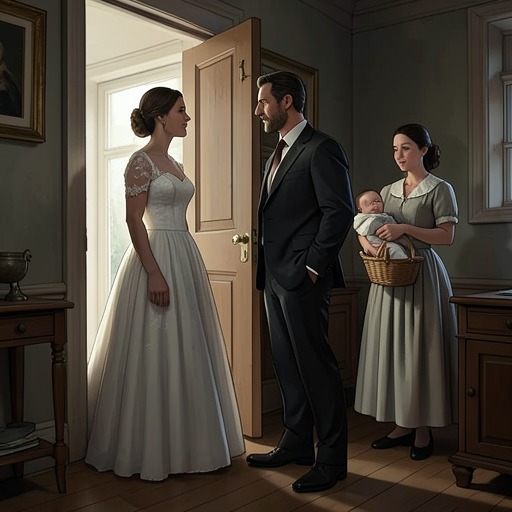
Wedding night
The Second SexThe wedding night is a decisive threshold in the text’s account of marriage: public ritual promises a union, but the private encounter may expose the couple’s unequal expectations, lack of preparation, and difficulty recognizing one another as free individuals. Rather than treating first intercourse as a simple biological event or a duty automatically fulfilled by marriage, the account examines how virginity, social authority, and the solemnity of a supposedly lifelong bond can turn sexual initiation into an ordeal. Its consequences may reach beyond the night itself, shaping a woman’s later experience of desire, marriage, and freedom.
Ritual, Virginity, and Ownership
The custom of the wedding night is set against varied sexual traditions. The text says virginity was not required of a new wife in some earlier matriarchal communities, where defloration might instead occur before the wedding; it also notes that some French regional customs retained less restrictive attitudes toward premarital sex. By contrast, paternalistic ethics demand that a bride arrive as a virgin. That demand is tied to a husband’s wish for exclusive possession of her body and to the moral, religious, and mystical value assigned to virginity.
In some French regions, the ritual’s claim of ownership becomes public: the husband’s friends wait outside the bridal chamber, laughing and singing until he emerges with a bloodstained sheet, or the sheet is shown to neighbors the next morning. The wedding night remains widespread in less brutal forms. The text reads such practices as signs that society has made the bride’s body evidence of marital possession, rather than treating sexuality as an experience whose meaning depends on the freedom and recognition of both partners.
Ceremony and Private Experience
The contrast between wedding ceremony and private reality is made vivid through a recollection by Colette. At thirteen, attending a peasant wedding, she is taken by a girlfriend to see the newlyweds’ bedroom. The bed, prepared as the final scene of the celebration, makes her confront what the feast and ceremony have left unspoken. Her distress registers the gap between a marriage publicly represented through solemn rites and the singular encounter awaiting the couple in private.
The account argues that the wedding’s abstract social meaning cannot guarantee a humane private experience. In a society that treats its members as individuals, guests may snigger because it is these particular people who will enter the bedroom, while public language and ceremony veil the physical reality of the encounter. Young women who have received little sexual education may return to their mothers in tears; the text gives the example of Mme Adam, who believed that a kiss on the mouth completed sexual union, and cites a report by Wilhelm Stekel of a bride who misunderstood her husband’s actions because she thought he must be mentally unsound. These examples show not simply ignorance, but the consequences of leaving a major change in intimate life surrounded by secrecy.
Consent, Shock, and Lasting Consequences
Even when a young woman is better informed, the text argues, her consent may remain abstract. It cites Havelock Ellis’s observation that rape may be more common within marriage than outside it, and reports that a group of six intelligent, married, middle-class women all experienced intercourse on their wedding nights as a shock; two had known nothing beforehand, while the others had expected to understand it and were nevertheless psychologically wounded. The point is that information alone cannot make an encounter freely assumed when the surrounding institution treats intercourse as an obligation.
The account emphasizes that initiation involves both physiological and psychological adjustment, and criticizes the attempt to compress that process into a single night or to transform first intercourse into a duty. A husband may be anxious and inexperienced as well as the bride; his own shame or confusion may result in clumsiness, hesitation, or excessive force. Yet the marriage’s solemnity and the assumption that it is definitive can make the event seem to determine the woman’s future. The husband comes to embody Man in her eyes, even though he is also a person she has not yet learned to know in this way.
The text describes a double bind in the young woman’s response: she may want pleasure and recoil from it, while asking for tenderness that can itself frustrate her. The husband may therefore seem clumsy if he hesitates or libertine if he advances too forcefully. Whatever the immediate reaction, the encounter can acquire an outsized meaning because both partners are burdened by convention and personal anxieties rather than able to attend generously to one another. The text warns that a painful or coercive initiation may contribute to lasting sexual insensitivity and that the wedding night can, in some cases, leave a woman sexually unresponsive thereafter.
A Threshold Between Conditions
The wedding night is also situated within a broader transition from girlhood to adult life. The text compares its anxieties with the earlier crisis of puberty: marriage brings a young woman abruptly into a new condition, while the expected honeymoon temporarily removes her from ordinary social ties and routines. When she returns to her new home, she must take her place in a life that may feel less secure than the family world she has left. The separation from her father’s household can feel like both abandonment and freedom, especially when her ties to her mother and siblings remain strong.
The expected promise of erotic fulfillment often fails to settle this upheaval. The text says that the day after the wedding may bring disgust at the experience and apprehension about its repetition, as well as disappointment. In this way, the wedding night does not simply mark a passage into marriage: it can reveal how little control the bride has over the terms of that passage.
Social Meaning and the Question of Freedom
The analysis of the wedding night belongs to the book’s larger existential argument. Human freedom is realized through projects and movement toward an open future; woman’s situation, however, is structured by demands that she accept herself as the Other, an object whose future is defined by another. The bridal ritual concentrates that conflict into an intimate setting: marriage publicly announces a shared bond, while the virginity requirement and expectation of conjugal duty can place the woman under her husband’s authority.
That framework also explains why the text distinguishes biological events from social destiny. It treats the body as important to a person’s situation but rejects biology as a fixed explanation of women’s subordination. The wedding night’s significance therefore lies not in an inevitable bodily fate, but in the conventions that shape what the encounter is expected to mean and who has the power to define it. For the text, a genuinely moral erotic life requires desire and pleasure to be freely assumed and the other person to be recognized as an individual; ritual and legal marriage alone cannot provide that recognition.